

If your safe handle won’t turn, stop forcing it and use only the normal operation described in the exact model manual. Record the lock’s response without sharing the combination, preserve ownership information, and contact the manufacturer or a suitable safe-service provider. A handle symptom alone cannot establish why the safe remains closed.
This checklist is for an owner or authorized representative in Albuquerque. It helps prepare a service request; it does not explain bypass methods, drilling, manipulation, or ways to defeat a safe’s protection.
Safe handle won’t turn: identify the safe first
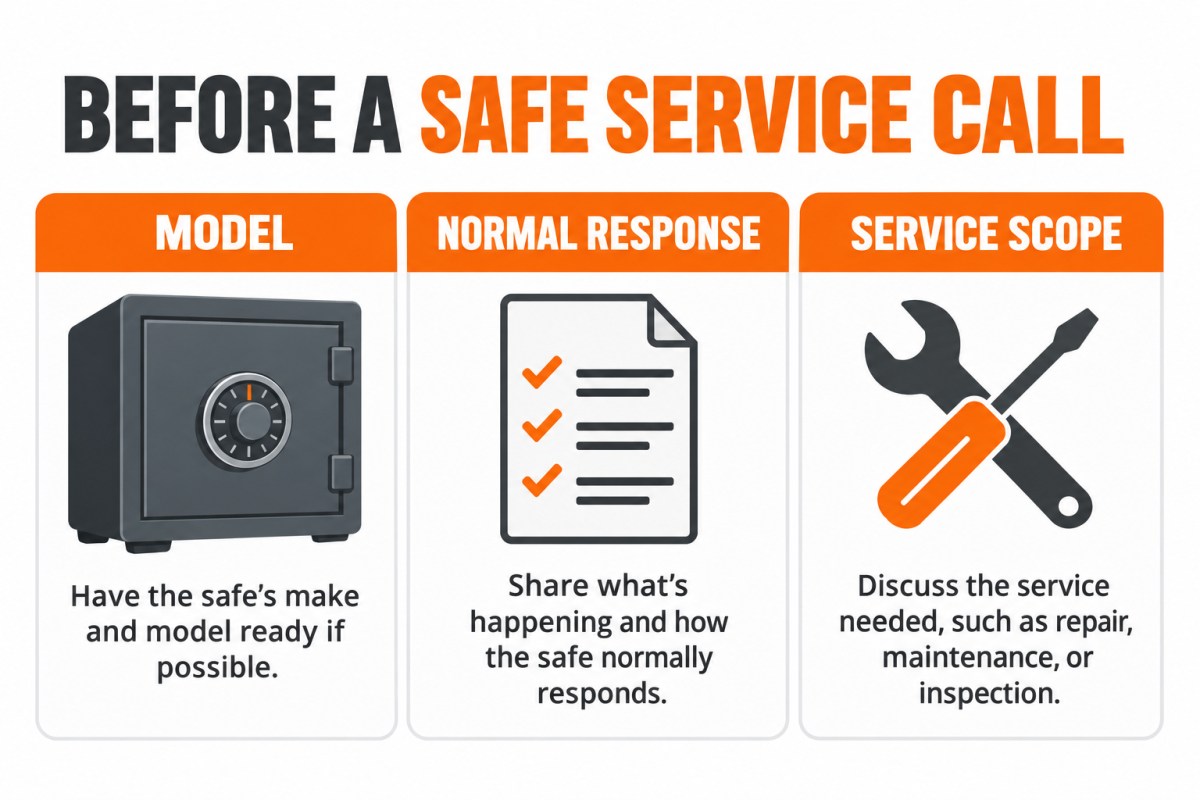
Record the brand and model from documents or accessible exterior information. Note whether the safe uses a dial, keypad, or another normal user control. Do not move a heavy safe, remove trim, or open electrical covers to find identification. If information is inaccessible, explain that to the provider.
Different products can use very different normal operating sequences. A light or sound on one model may have a different meaning on another. Follow the actual manufacturer’s instructions and avoid treating an online video of a similar-looking safe as proof of how yours should behave.
| Information to record | Why it helps | What to keep private |
|---|---|---|
| Brand, model, and lock type | Supports product-specific advice and coverage checks | Combination and personal access credentials |
| Normal light, sound, or display response | Distinguishes observations without guessing a cause | Any complete code-entry recording |
| When the safe last opened normally | Provides a useful symptom history | A list or photographs of stored valuables |
| Whether the safe was moved or serviced recently | Gives context for inspection | Unnecessary location and security details |
Preserve the condition instead of adding force
Do not extend the handle with a tool, strike the door, pry at its edges, or keep trying different combinations. Repeated attempts can make it harder to distinguish the original complaint from later damage or product-specific lockout behavior. Follow the manual’s instructions if it indicates a waiting period.
A recognized code response and a handle that physically moves are different observations. Describe both without concluding that the lock has fully released or that a specific internal part is jammed. Diagnosis may require an appropriate technician and the correct product information.
SentrySafe’s customer support page organizes assistance by model information, product manuals, opening help, and key or combination recovery. That is a useful example of a manufacturer-led support route. Use the equivalent resources for your own safe rather than assuming one brand’s instructions apply to another.
Prepare an authorized home-safe request
Discount Locksmith of Albuquerque lists home safe unlocking. Confirm the specific brand, model, lock type, and requested outcome before booking. A listed service does not establish support for every safe, guarantee a particular opening method, or promise preservation of every component.
Ask which ownership or authorization records are required and how they should be provided. If the safe belongs to an estate, business, landlord, or another person, explain who can approve access. Do not treat possession of the safe or knowledge of its location as automatic authority to request entry.
Keep the combination out of public messages
A first inquiry can describe the safe and symptom without disclosing its code. Agree directly with the verified provider on any information needed for the actual service. Avoid photographs or videos that reveal credentials or contents, especially in public reviews, forums, or social messages.
The company information page and contact page help you identify the business and establish a direct conversation. Confirm the person arranging the visit and the approval process before sharing private access information.
Clarify the proposed result and its limits
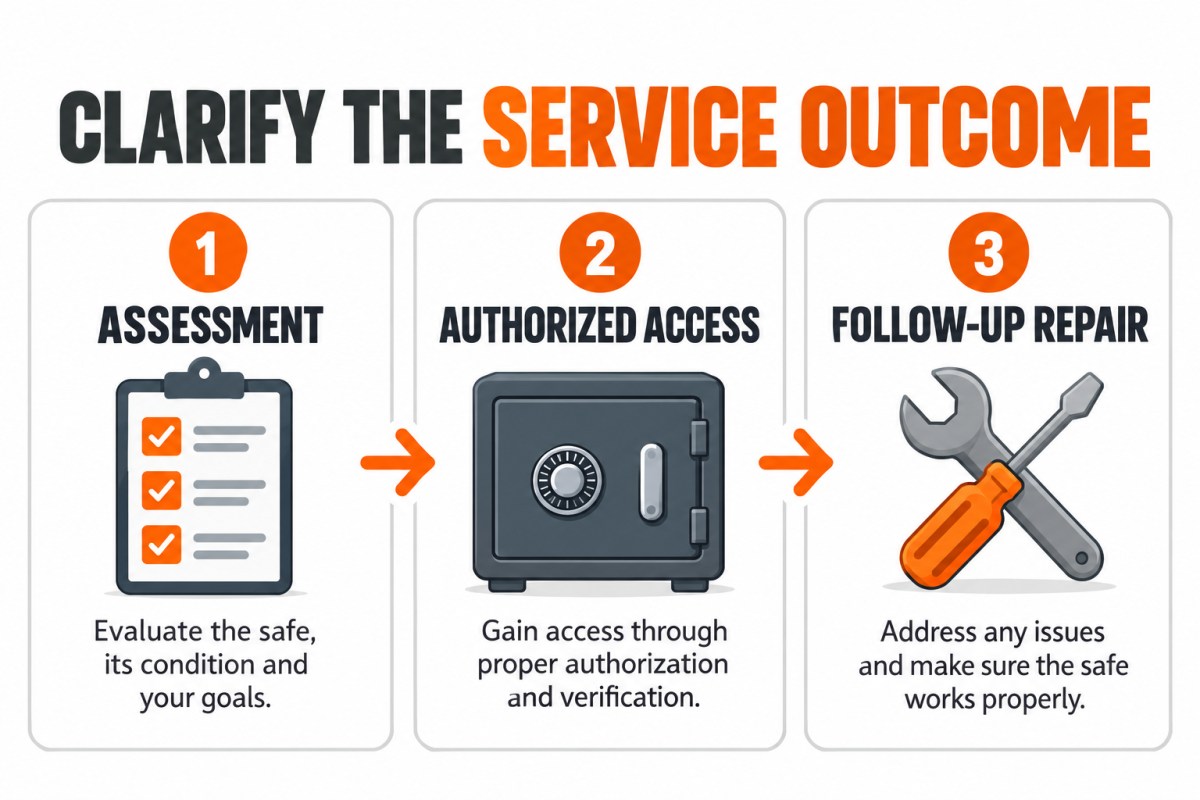
- Does the visit cover assessment, authorized opening, repair, or more than one outcome?
- What findings could change the proposed method or estimate?
- How will any need for parts or a specialist be handled?
- What must be approved before work that alters the safe begins?
- Will the safe be suitable for normal use afterward, or need further service?
Opening and returning a safe to reliable service are not necessarily the same task. Ask what remains unresolved if access is restored. A product’s protection claims or warranty should not be assumed unchanged after damage or alterations; confirm those matters with the manufacturer for that product.
An example of a useful symptom description
Illustrative example, not a reported company job: An owner says a keypad gives its usual response but the handle does not move through the normal range. The owner provides the model and notes that the problem began after the last ordinary use. This is useful information without claiming to know the internal cause or publishing the code.
If you need a broader property appointment, review the residential locksmith services and keep the safe work separately defined. Use the service overview to identify related needs without assuming a general door-lock visit includes specialist safe work.
A useful record when your safe handle won’t turn
Prepare one concise account of the last normal opening and the first unsuccessful attempt. Record whether anyone else used the safe in between, whether it was moved, and whether any service was performed. Keep facts separate from conclusions. A note that the handle stopped at a different position is useful; a claim that an internal component has failed is a diagnosis that still needs appropriate assessment.
If the safe handle won’t turn, describe the response of the ordinary user control without sharing its secret information. State whether the display behaved as usual or showed a different message. You can report a sound or indicator without sending a video of the combination being entered. That distinction protects access information while giving the provider a clear description of the complaint.
Identify who can approve the work
Agree on the responsible person before arranging a visit. In a household, that may be the owner. In a business or estate, another authorized representative may need to approve the request. Explain the arrangement early so the provider can tell you what verification is required. This is more useful than assuming the person present at the property can authorize every proposed action.
Keep a copy of the approved scope with the service record. If more than one person uses the safe, tell the other authorized users that the symptom is unresolved and that repeated attempts should stop. Do not pass along a forceful workaround. The record should help everyone distinguish ordinary access from an outstanding condition that needs attention.
Compare service proposals when a safe handle won’t turn
An estimate can describe assessment, authorized opening, repair, parts, or some combination. Ask which outcome is included and what happens if the inspection changes the recommendation. A proposal for access alone is not directly comparable with one that includes returning the safe to normal use. Clarify the difference before deciding which arrangement fits your need.
When a safe handle won’t turn, useful questions concern product support, approval, and the condition afterward. Ask how additional work will be explained before it begins. Discuss whether any change could affect future use, product protection claims, or a manufacturer service route. The provider should identify uncertainty instead of presenting an unexamined symptom as proof of a particular repair.
| Stage | Question for the provider | Record to keep |
|---|---|---|
| Identification | Is this model within your service scope? | The model information used |
| Authorization | Who must approve access and further work? | The agreed verification process |
| Assessment | What is known and what still needs inspection? | The reported symptom and findings |
| Completion | Is the safe ready for ordinary use? | Tests, remaining work, and instructions |
Four situations that need different descriptions
1. An unfamiliar safe with no operating history
A new owner may not know whether the current behavior is a change. Say that clearly instead of borrowing a diagnosis from another model. Locate available paperwork and ask the manufacturer or confirmed provider to identify the correct normal operation. Ownership and authority still need to be established through the appropriate process.
2. A previously reliable safe with a new symptom
If the safe handle won’t turn after years of ordinary use, the date of that change matters. Explain what happened during the last normal use and whether anything else changed. Do not create more unsuccessful attempts to gather extra detail. A clear history of one change is often more useful than a long list of experiments performed afterward.
3. A product that was moved recently
Report the move without deciding it caused the problem. The service provider needs the context and the present condition. Do not move the safe again to test the theory, especially if it is heavy or fixed in place. Explain access conditions at the location so the provider can plan the appropriate assessment.
4. Access restored but reliability unresolved
Opening once does not settle whether the safe can be returned to routine use. Ask what remains to be assessed before closing it again. If your safe handle won’t turn consistently, that condition belongs in the handover record even if access was eventually restored. Do not let the immediate relief of access replace the repair decision.
A handover checklist for the owner
Keep the final record focused on what the provider actually did and demonstrated. Ask for the product identification, approved work, any parts, and the stated limitations. You do not need confidential technical opening details. You do need to know whether the safe is suitable for normal operation or requires a separate repair or manufacturer review.
Discuss the normal user test with the provider and follow the instructions appropriate to the product and its current condition. Confirm what should happen before the safe is closed with contents inside. If a test is deferred, have the reason and next step recorded. Do not assume that the same action used during a service procedure should become a household operating method.
If the safe handle won’t turn again, refer to the service record and describe the recurrence through the confirmed contact route. Avoid adding force or trying undocumented procedures. An accurate report of the repeated symptom helps the provider assess the next step without reconstructing what happened from memory or from incomplete messages.
Store the service record and credentials separately through a process appropriate to the household or organization. Keep the combination out of the invoice notes shared with unrelated parties. The aim is a clear history of authorized work and intended operation, while access information remains available only to the people who should hold it.
Information the first inquiry does not need
A first appointment request usually does not need an inventory of the contents, photographs of documents, or a description of other security arrangements in the property. Start with the safe identification, the observed symptom, and the authority to request service. If further information is necessary, ask why it is needed and how it should be provided through the confirmed business process.
Keep scheduling details separate from access credentials. A message explaining when an authorized person can meet the provider is different from a message disclosing a combination. Review photographs before sending them so a reflected document, an address label, or a code note is not included accidentally. A useful exterior photograph can often identify the product without revealing the contents.
If more than one party is involved, agree on who receives the final service record and who manages the normal access information afterward. Avoid creating a new shared document that combines all private details merely for convenience. Clear responsibility helps the owner arrange follow-up if the safe handle won’t turn again, while keeping the service history distinct from the credentials used for ordinary access.
Frequently Asked Questions
If my safe handle won’t turn, does a keypad response prove it unlocked?Not by itself. The meaning of a light, sound, or display depends on the model and normal sequence. Report the response accurately and whether the handle moves as expected. Avoid deciding that a specific internal component has failed solely from an indicator or a similar-looking product online. |
Should I pull harder if my safe handle won’t turn?No. Do not add tools, body weight, impact, or leverage to overcome resistance. Preserve the safe in its present condition and use only its documented normal operation. Explain any force already applied so the provider can distinguish the original symptom from damage that may have happened afterward. |
Can I send the combination in the first inquiry?Begin with model and symptom information instead. Confirm the provider and agree on the appropriate private process before sharing access credentials if they are needed for authorized work. Do not post the combination, complete code-entry recordings, or photographs of valuable contents in public messages or support forums. |
What model details help when a safe handle won’t turn?Check existing paperwork or accessible exterior markings without moving a heavy safe or removing parts. If the information remains unavailable, say so and ask what safe identification the provider can use. An intact exterior photograph may help, but confirm what should be included and keep credentials out of view. |
Is knowing the code enough to authorize a service visit?The provider may need ownership or authority verification in addition to operational information. Ask what applies to your circumstances, especially for a business, estate, rental property, or safe owned by someone else. Do not assume a universal document list or that knowing the location establishes permission. |
Should I keep trying if the safe shows a waiting message?Follow the product manual and stop repeated attempts. Waiting or lockout behavior is model-specific, and continuing to enter different combinations may complicate the situation. Record the message without recording the code, then consult the manufacturer or confirmed service provider for the appropriate next step. |
Can an ordinary door locksmith service every safe?Safe coverage depends on the provider, product, lock type, equipment, and requested work. Confirm those details before booking. Ask whether assessment, opening, and repair are available for the actual safe and what would require another specialist rather than treating a broad locksmith service listing as universal coverage. |
Does opening the safe mean it can be used normally again?Not necessarily. Restoring access and restoring reliable operation are separate outcomes. Ask what inspection and repair remain after opening, whether parts are required, and what tests are appropriate before closing it again. Confirm any protection or warranty question directly with the manufacturer for that product and condition. |
What if important documents are needed soon?Explain the practical urgency and ask for confirmed options and availability. Avoid assuming a guaranteed arrival or opening time, and consider legitimate alternative sources for needed documents when possible. The urgency should help prioritize the request without replacing authorization checks or changing the need for a suitable assessment. |
What should I retain after the appointment?Keep the approved scope, service record, product details, and any instructions for further repair or normal use. Store credentials separately through your own secure process. Document any remaining condition so another authorized owner or technician does not assume the safe was fully repaired just because access was restored. |
Final Thoughts
If a safe handle won’t turn, preserve the product and establish the authorized support route. Model information, a precise symptom description, and an agreed service scope are more useful than force or repeated attempts.
Call Discount Locksmith of Albuquerque at (505) 210-8802 or contact the team to confirm the service scope, compatibility, and current availability.