

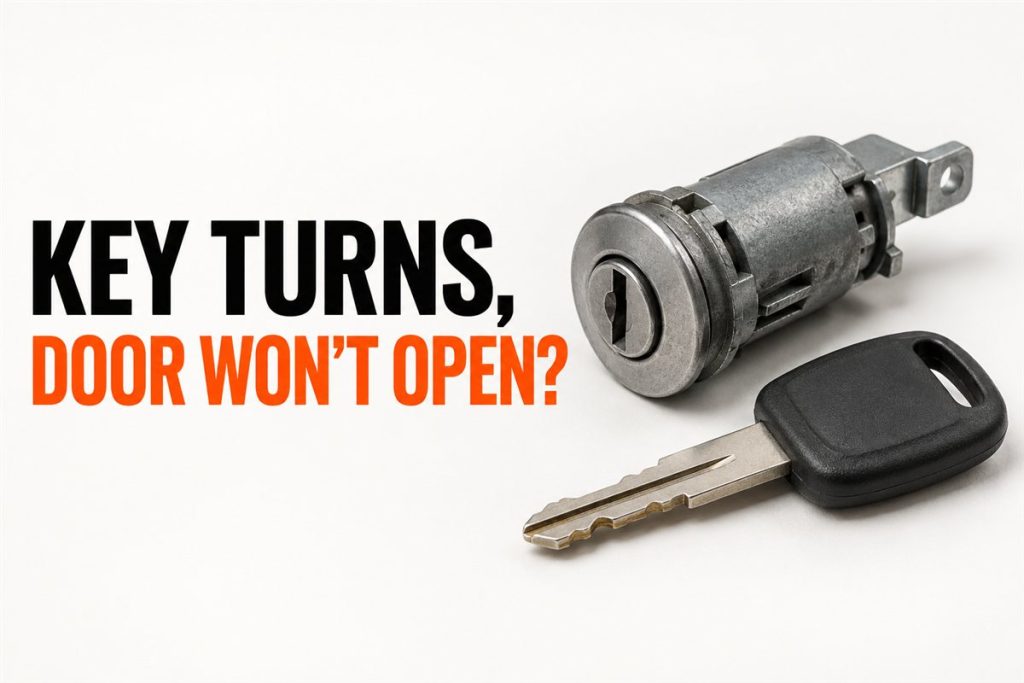
If your key turns but car door won’t unlock, stop adding force and note exactly what moves. Cylinder rotation, the lock indicator, and the door latch are different parts of the operation. A turning key does not establish that the door has unlocked or that a replacement key will solve the problem.
This guide helps an authorized driver in Albuquerque describe a mechanical door-lock symptom. It does not cover entry techniques or methods for reaching internal locking components.
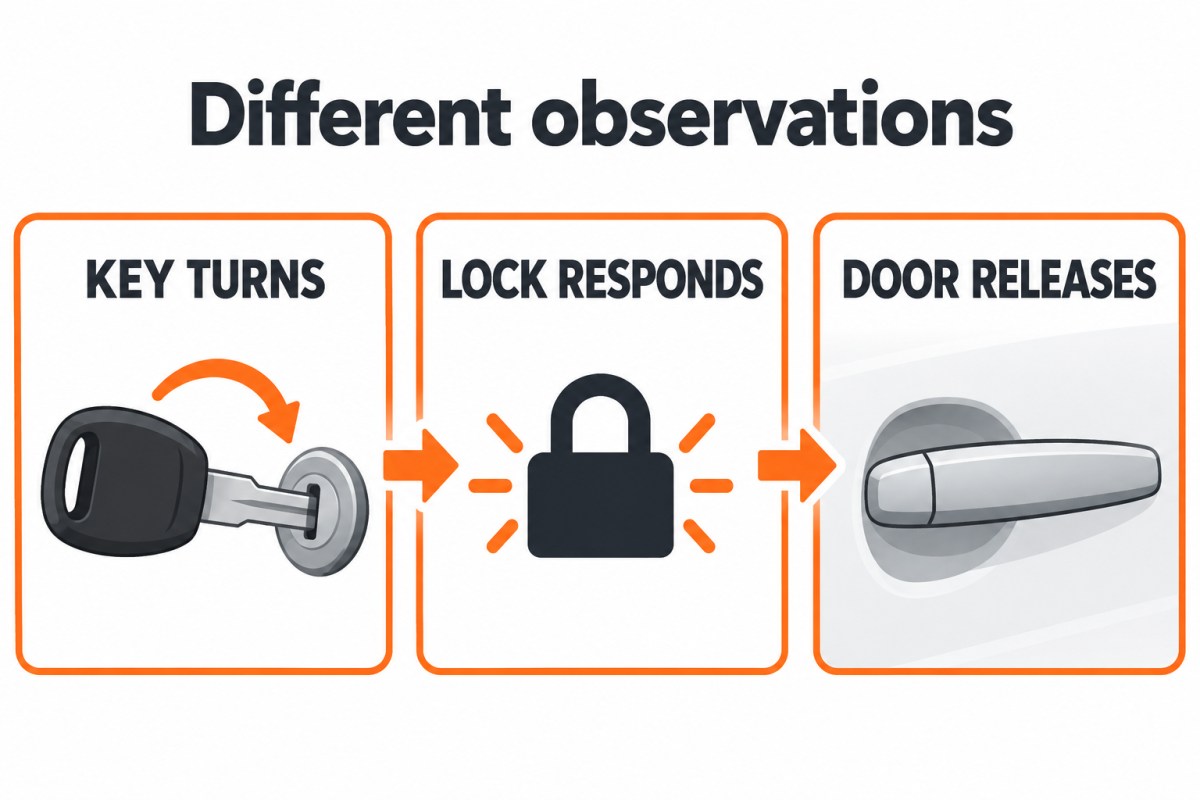
Key turns but car door won’t unlock: separate the observations
Describe whether the key travels through its usual range or rotates farther than it used to. Does the lock indicator change? Does the handle move normally? Does the door remain shut even when an authorized remote reports an unlock? These details help distinguish a cylinder complaint from a door-release complaint without opening up the door.
Do not assume that one exterior key operation should unlock every door on every model. Vehicle features and settings vary. Use the correct owner manual to establish the expected behavior before deciding which part is failing.
| Observation | Useful distinction | What to report |
|---|---|---|
| Key turns through its normal range but indicator does not change | Rotation is not producing the expected locking response | Whether another authorized method behaves differently |
| Indicator changes but door remains shut | Unlocking and latch release may be separate concerns | Handle behavior and the affected door |
| Key rotates unusually far | Cylinder or related mechanical operation needs inspection | When the change began |
| Remote works but mechanical key does not | The backup mechanical function needs assessment | Whether the blade has ever worked in this cylinder |
Use ordinary authorized checks only
If you already have a working remote or another authorized entry method, report how it behaves. Do not insert tools into the door, pull at trim, or repeatedly twist the key. A blade that starts bending or a cylinder that moves abnormally is a reason to stop.
Ford’s lock and unlock information illustrates the range of manual and remote options on supported vehicles and directs owners to their own manuals. It does not establish the expected behavior of every car or the cause of this symptom.
When someone is in immediate danger inside a vehicle, contact emergency services. Otherwise, find a safe place to wait and explain whether you need entry assistance, mechanical repair, or both. Those are different service outcomes.
Why a new key is not automatically the answer
A damaged key can affect operation, but rotation without the expected response may involve the cylinder or the mechanism it operates. If a door unlocks but will not open, a different part of the door assembly may require inspection. Do not order a replacement blade or complete remote solely from this symptom.
Discount Locksmith of Albuquerque lists car door lock repair and car lock cylinder replacement separately. Ask which inspection findings support either option and confirm coverage for the exact vehicle year, make, model, and key design.
If the blade has never worked in this door
Say so. A newly obtained blade that looks correct is not the same diagnostic reference as a key that reliably operated the door for years. Tell the provider whether it was tested previously and whether any door cylinder has been replaced. Mechanical fit and electronic starting authorization are separate questions.
The existing car key replacement guide covers replacement planning. This article addresses the narrower symptom of key movement without the expected door response and helps determine what needs inspection first.
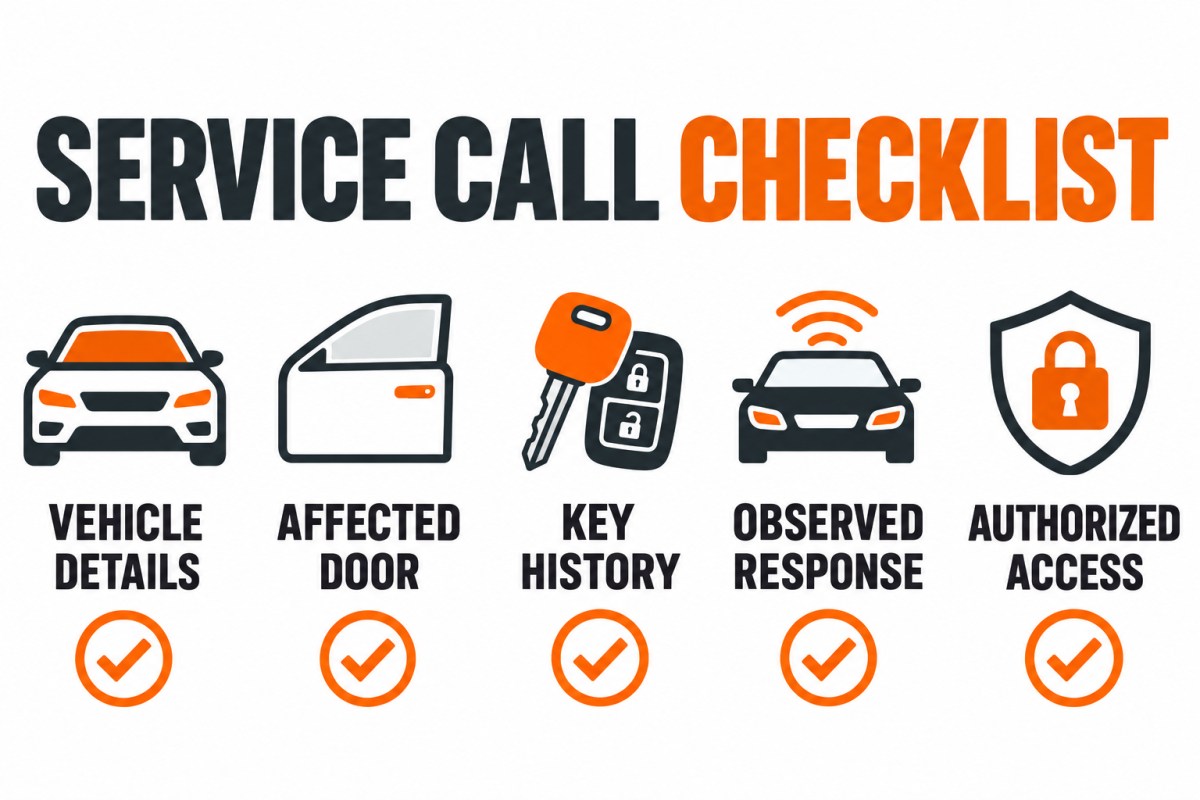
5 checks when your key turns but car door won’t unlock
- Vehicle year, make, model, and affected door.
- Whether the key turns normally, binds, or moves unusually far.
- Whether the lock indicator or handle responds.
- What an existing authorized remote or spare does.
- Any prior cylinder work, damage, or unsuccessful repair attempt.
Ask what proof of ownership or authority is required and how the provider verifies it. Confirm visit scope, possible parts, estimate approval, and whether another vehicle specialist may be needed. Use the automotive locksmith service information to describe related needs without assuming universal model support.
Agree on the final test before work starts
Illustrative example, not a reported company job: A driver’s remote opens the car normally, but the mechanical key turns without changing the door lock state. The useful request covers the mechanical backup operation; it does not begin by assuming the entire remote needs replacement. Inspection determines the repair.
At handover, ask for testing of the agreed mechanical and authorized remote functions. Confirm how any replacement cylinder affects existing keys, retain the service record, and report remaining inconsistency. Contact the team to confirm the actual work and current availability before arranging access.
A symptom worksheet when a car door won’t unlock
Write a short account of one ordinary attempt rather than a list of possible causes. Start with the door involved, the key used, and what happened after a normal turn. Include the final result: no lock response, a changed indicator without release, or a door that opens only through another authorized control. Keep observation separate from interpretation so the person receiving the call does not mistake a guess for a confirmed finding.
If the key turns but car door won’t unlock, a useful report might say that the driver door indicator stays unchanged, while the existing remote opens that same door normally. A different report might say the indicator changes but the outside handle does not release the door. Those are different service descriptions even if both drivers initially call the problem a broken lock.
Record whether the problem began suddenly or developed gradually. A key that has always been untested deserves a different note from a long-used key that changed yesterday. Mention previous door work, a replacement cylinder, or a known impact if you have that history. Do not invent a cause because it seems likely, and do not create additional attempts just to complete a worksheet.
When a car door won’t unlock, describe one door at a time
For each affected opening, distinguish normal locking, normal unlocking, and normal opening. A complaint about the driver door should not automatically become a diagnosis for every passenger door. If other doors behave normally, that comparison is useful. If the vehicle normally unlocks only one door first, its documented settings matter. Let the owner manual establish the expected result before labeling other doors faulty.
Keep your notes brief enough to use during the appointment. A date, the affected door, the established key history, and the observed response are usually clearer than a video of repeated attempts. If the provider requests a photograph, ask what should be visible. Avoid including registration documents, home addresses, key cuts, or other private information unless it is needed through the agreed verification process.
If your car door won’t unlock, separate the estimate into outcomes
A clear estimate should explain what you are approving, what is still uncertain, and how additional work will be authorized. The first line may cover assessment rather than a guaranteed repair. Ask whether the quoted scope includes entry assistance, inspection of the mechanical door function, replacement components, or key-related work. A single price without a defined outcome is harder to compare with another proposal.
When your key turns but car door won’t unlock, the inspection may lead to a recommendation outside the original description. Ask the provider to explain the finding in plain language before approving that change. You do not need to identify internal parts yourself, but you should understand which function the proposed work is expected to restore and which functions are outside the estimate.
| Estimate item | Question to ask | Useful confirmation |
|---|---|---|
| Assessment | What will be evaluated before parts are selected? | The affected door and reported function |
| Entry assistance | Is authorized access a separate item? | Whether repair remains after entry |
| Parts | How is compatibility established? | Vehicle-specific support and availability |
| Key arrangement | Will the existing key still operate this door? | Which keys are supplied or retained |
| Completion | Which operations will be demonstrated? | A shared understanding of the final test |
Compare proposals when a car door won’t unlock
One provider may quote a diagnostic visit while another describes replacement work. Those are not directly comparable until you know what each includes. Ask about parts, additional authorization, and what happens if the first assessment points to another specialist. Do not assume a lower initial figure covers the same result or that a more expensive proposal necessarily includes every related vehicle function.
Ask how the business handles customer-supplied parts before buying anything. A listing that names your vehicle family may still leave unanswered questions about the exact component or key arrangement. Discuss the proposed purchase with the provider who will perform the work. Keeping that decision connected to the inspection reduces the chance of approving a part that does not address the complaint.
3 useful comparisons when a car door won’t unlock
1. An unproven blade versus a previously reliable key
A driver discovers the mechanical blade for the first time and finds it does not produce the expected result. Another driver has used the same key successfully for years before a change appears. The first case includes a basic question about the key’s history. The second includes a change in established operation. Neither establishes the answer by itself, but the distinction belongs in the initial request.
2. A lock response versus a door-release response
If an indicator responds but the door remains shut, describe both events. Do not stop the report at the word unlocked. If nothing changes after key rotation, say that instead. These observations help a provider understand why a simple key replacement may not be the complete request. They also avoid assuming that every closed door is still locked in the same way.
3. Restored entry versus restored backup operation
Getting inside through a working authorized remote can solve an immediate access need while leaving the mechanical backup unresolved. If your key turns but car door won’t unlock, decide whether the appointment is intended to restore that backup too. Make this explicit before the visit ends so successful entry is not mistaken for completion of the mechanical repair.
A practical handover record
Ask the provider to state what was inspected, what was changed, and what was tested. Keep the wording connected to the original complaint. For example, a record of restored mechanical driver-door operation is more useful than an unexplained note saying lock fixed. If another system remains outside the scope, have that limitation identified so you can arrange an appropriate follow-up.
Test the agreed function through ordinary authorized operation while the provider is present, when circumstances allow. Confirm which key is being tested and which door it is intended to operate. Ask questions if the result requires unusual force or repeated attempts. Do not accept an unexplained workaround as normal operation simply because the door eventually opens once.
If your key turns but car door won’t unlock again after service, report the recurrence with the original service details and the conditions observed. Avoid repeating forceful tests or changing unrelated settings before contacting the provider. The record gives the next assessment a starting point and helps distinguish a recurring complaint from a new, separate problem.
Finally, keep spare-key planning separate from the repair finding. An intact authorized spare can be useful, but making another copy does not prove that a door mechanism has been restored. When the key turns but car door won’t unlock, the final decision should follow the observed door function, the inspection, and the result demonstrated at handover.
Frequently Asked Questions
Does a turning key prove the cylinder is working correctly?No. Rotation is only one observation. Explain whether the lock state changes and whether the door releases normally afterward. A technician needs to consider the cylinder and the function it operates. Avoid assuming the component is sound simply because the blade can move inside it. |
What if the remote still opens the door?That comparison helps identify a difference between remote operation and the mechanical backup. It does not prove a specific failed part. Preserve the working authorized method and request assessment of the key-and-cylinder function rather than assuming a new remote is necessary to correct the mechanical symptom. |
Can the latch fail even when the lock appears unlocked?A door staying shut after an apparent unlock is a different observation from the lock indicator never changing. Describe handle behavior and which door is affected. Do not pull harder or dismantle trim to investigate; an inspection can determine whether the locking and release functions need separate attention. |
Should I try a newly copied key?Tell the provider which keys have previously worked and which are unproven. A newly copied blade may introduce another fit question and is not a substitute for diagnosis. Do not repeatedly test it in a cylinder that moves abnormally or force any blade that begins to bend or bind. |
Will replacing the cylinder mean a different key for that door?Possibly, depending on available parts and the agreed key arrangement. Discuss that before approving replacement so you understand which keys operate the completed installation. Ask about compatibility with existing keys and whether any electronic functions are involved; those outcomes should be stated separately in the estimate. |
Could expected unlocking behavior vary by model?Yes. The doors affected by a normal key or remote operation can vary with model, equipment, and settings. Use the manual supplied for the specific vehicle as the reference. Report a change from its established behavior rather than assuming that a procedure for another vehicle should apply. |
What should I avoid spraying into the lock?Do not apply unidentified household products or assume lubricant will reconnect a mechanism that is not responding. Ask for product-specific guidance and report anything already applied. Keep the keyway free of improvised tools, adhesives, and additional material that could complicate the original complaint or a later inspection. |
Is entry assistance the same as repairing this problem?No. Entry assistance may restore authorized access without repairing the cylinder or door mechanism. State whether both outcomes are needed and confirm the visit scope. A spare or remote that lets you inside also does not establish that the mechanical backup has become dependable again. |
Can every automotive locksmith handle every door system?Coverage depends on the vehicle, equipment, parts, and the proposed work. Give exact vehicle details and confirm support before booking. Ask whether service can be performed at your location and what findings might require another repair facility, rather than treating a broad service listing as universal coverage. |
What should I verify after repair?Test the functions included in the agreed scope, including the appropriate mechanical key and any related authorized controls. Confirm which existing keys remain valid and whether the door locks and releases normally. Retain the service record and report any remaining intermittent behavior with the conditions in which it occurs. |
Final Thoughts
When a key turns but car door won’t unlock, describe the cylinder, lock state, and door-release behavior separately. Preserve working access and let the inspection determine whether key, cylinder, or other door work is appropriate.
Call Discount Locksmith of Albuquerque at (505) 210-8802 or contact the team to confirm the service scope, compatibility, and current availability.