

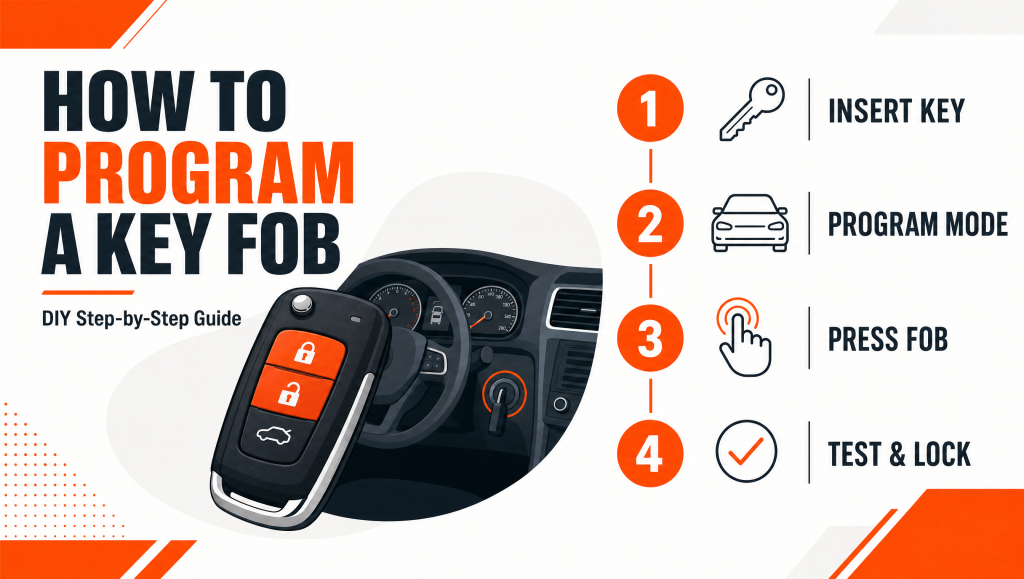
You can program a key fob yourself on many American-made vehicles built before roughly 2015 by cycling the ignition in a set sequence until the door locks click, then pressing a button on the remote within the timeout window. This “onboard programming” pairs the remote’s lock and unlock function to your car with no tools. It does not work on push-to-start proximity fobs or transponder-chip keys, which need professional diagnostic equipment.
Losing a remote, buying a spare online, or replacing a dead fob shouldn’t mean an automatic trip to the dealer. On the right vehicle, learning how to program a key fob at home takes minutes and costs nothing beyond the fob itself. The catch is knowing whether your car actually supports the DIY method — and recognizing the moment it clearly doesn’t. Drivers across the metro rely on our Albuquerque locksmith team for exactly these calls, and the same principles apply whether you do it yourself or hire a pro.
This guide covers what you need before you start, the step-by-step onboard procedure, brand-specific sequences for Ford, Chevy, and Toyota, the situations where DIY simply can’t work, and how professional fob programming in Albuquerque fills the gap. As a licensed and insured automotive shop that programs remotes, transponders, and smart keys every day, we’ve built this from field experience — you can also see our location and reviews on Google Maps to know who’s behind the advice.
What You Need Before Programming
Onboard programming is a timing exercise, not a strength job. Success comes down to preparation and knowing which fob you’re holding. Before you touch the ignition, line up the following:
- A fresh fob battery. A weak battery is the number-one reason a “broken” programming attempt fails. Drop in a new CR2032 (or your fob’s size) first. If you’re unsure, our guide to keyless remote battery replacement walks through it by brand.
- Every fob you own. Most vehicles that support onboard programming require all remotes to be programmed in the same session. Any fob you leave out will stop working, so gather them all before you begin.
- At least one working key or fob. Many sequences need a remote that already pairs to the car. If you’ve lost every key, onboard programming won’t help — that’s a professional job, covered below.
- Your owner’s manual. Exact ignition-cycle counts and timeout windows vary by make, model, and year. The manual’s “keyless entry” or “remote programming” section is the source of truth for your specific car.
- The correct fob for your VIN. A remote must match your vehicle’s frequency and FCC ID. A mismatched or wrong-year fob will never pair, no matter how perfect your timing.
Confirm your fob type before anything else, because it decides whether DIY is even possible. There are three very different devices people all call a “key fob”:
| Fob Type | What It Does | DIY-Programmable? |
|---|---|---|
| Remote (RKE) | Locks/unlocks doors, trunk, panic from a distance | Often yes, on supported pre-2015 vehicles |
| Transponder chip key | Immobilizer chip lets the engine start | Rarely — needs a programmer + security PIN |
| Proximity / smart (push-to-start) | Keyless entry and push-button start | No — professional equipment required |
If you only need the remote lock/unlock function restored on an older vehicle, keep reading. If your car starts with a push button or the key has an embedded immobilizer chip, our smart key programming and professional key fob programming services cover what DIY can’t.
How to Program a Key Fob Step by Step
The onboard method below covers the remote-entry function on vehicles that support it — mostly domestic cars and trucks from about 1996 to 2015. Work with the doors closed, move quickly once you start, and keep every fob within reach. The general shape is the same across brands even though the exact cycle count differs.
- Sit inside with all doors closed. Programming mode reads the door and ignition state, so an open door can interrupt the sequence. Get in, close everything, and have all fobs on the seat beside you.
- Insert the key and cycle the ignition. Turn the key from OFF to ON (the “run” position, dashboard lights on — do not start the engine), then back. Repeat this ON/OFF cycle the number of times your make requires, usually between three and eight cycles, all within about ten seconds. Speed and count matter.
- Watch for the lock confirmation. When you’ve hit the right sequence, the door locks will cycle — you’ll hear or see them lock and unlock on their own. That click is the car telling you it has entered programming mode.
- Press a button on the fob. Within the timeout window (often 5 to 40 seconds depending on the make), press LOCK — or LOCK and UNLOCK together on some models — on the remote you want to pair. The locks cycle again to confirm the fob was accepted.
- Program any additional fobs. While still in programming mode, repeat the button press on each remaining remote, one at a time, within the same window. Every fob you want to keep must be paired now.
- Exit and test. Turn the ignition to OFF and remove the key. Step out, close the door, and test every fob — lock, unlock, trunk, and panic — from a few feet away. Each button should respond on the first press.
If the locks never cycle in step 3, you either missed the count or your vehicle doesn’t support onboard programming at all. Recheck the sequence in your owner’s manual once; if it still fails on the second clean attempt, the car most likely needs a diagnostic tool, and our remote key repair and programming service takes it from there.
Quick Diagnosis: Why a DIY Fob Won’t Program
| Symptom | Likely Cause | Fix |
|---|---|---|
| Locks never cycle | Wrong cycle count or unsupported vehicle | Recheck manual; confirm car supports onboard programming |
| Locks cycle but fob won’t pair | Weak fob battery or wrong FCC ID | Replace battery; verify the fob matches your VIN |
| One fob works, another doesn’t | Second fob left out of the session | Reprogram all fobs together in one sequence |
| Nothing responds after testing | Immobilizer/transponder not learned | Remote may pair but engine still needs pro chip programming |
| No sequence works at all | Push-to-start or encrypted platform | Professional OBD-II programming required |
By Car Brand (Ford, Chevy, Toyota)
Every manufacturer uses its own onboard sequence, and the differences are real. The procedures below reflect the common patterns for supported model years — always confirm the exact cycle count and timing in your owner’s manual, as they shift between model years.
Ford and Lincoln (roughly 2000–2016). With all doors closed, turn the ignition from OFF to RUN eight times within ten seconds, ending in RUN. The door locks cycle to confirm programming mode. Within about twenty seconds, press any button on the new remote; the locks cycle again to accept it. Program each additional fob the same way, then turn to OFF to exit. Fords are among the most DIY-friendly platforms for the remote function.
Chevrolet and GM (roughly 2007–2016). Insert the key and turn to ON without starting the engine. Press and hold the UNLOCK button on the driver’s-door panel; while holding it, press and release the door LOCK button three times, then release UNLOCK. The locks cycle to signal programming mode. Press LOCK and UNLOCK on the new remote at the same time until the locks cycle to confirm. Some GM models use an ignition-cycle variant instead, so check the manual for your exact year. Our automotive locksmith team handles the GM models that fall outside the onboard window.
Toyota (roughly 1998–2015). Toyota’s remote sequence is the fussiest of the three. Sit in the driver’s seat with the doors closed, then insert and pull the key from the ignition twice within five seconds. Open and close the driver’s door twice. Insert and pull the key once, then open and close the door twice more. Insert the key, close the door, and turn the ignition ON and OFF once (engine off). Remove the key — the locks should cycle. Within about forty seconds, press LOCK and UNLOCK on the remote together, release, then press LOCK alone; the locks cycle to confirm. Toyota’s newer SmartKey and H-key systems do not support this and need professional tools.
Other domestics and imports follow similar logic. Nissan models from about 2002–2015 use an insert-and-remove sequence (pulling the key from the ignition six times in ten seconds), and many Hondas from 2001–2013 support an onboard routine as well. When your make or year isn’t listed, a licensed locksmith can confirm it and, if needed, program the fob for you on site.
When DIY Won’t Work
Onboard programming is a fading feature. Automakers have steadily moved remote entry behind the same encrypted security that protects the engine immobilizer, and that shift closes the door on the ignition-cycle trick. Recognizing these cases up front saves you a frustrating hour in the driveway.
DIY programming will not work when:
- Your car uses push-to-start / a proximity fob. Keyless-go smart keys authenticate with rolling encryption and must be enrolled with a diagnostic programmer. No ignition sequence exists for them.
- The key has a transponder immobilizer chip. Even if the remote buttons pair, the engine won’t start until the chip is programmed to the car — a separate operation that often requires a manufacturer security PIN. This is the difference between transponder key programming and simple remote pairing.
- You’ve lost all keys. Most onboard sequences need one working key already paired. With none, the car must be accessed and initialized with professional equipment.
- The vehicle is a 2016-or-newer or European model. Post-2015 platforms, plus most BMW, Mercedes, Audi, and VW MQB vehicles going back further, use encrypted pairing with no onboard option.
- The locks never respond after two clean attempts. If a correct sequence produces nothing, the platform simply doesn’t support onboard programming.
In every one of these cases, the fix isn’t a harder DIY attempt — it’s the right tool. A licensed automotive locksmith carries OEM-level programmers and secure access to manufacturer key codes through channels like the National Automotive Service Task Force, which governs secure vehicle key and immobilizer data. That’s what lets a pro cut, pair, and immobilizer-match a key that ignition cycling can never touch. If you’re weighing the trade-offs, our breakdown of car key replacement cost shows where DIY savings end and professional value begins.
Professional Fob Programming in Albuquerque
Plenty of drivers pair an older Ford remote on a Saturday and never think about it again. But when the fob is a smart key, the chip won’t learn, or every key is gone, professional programming is faster, cheaper over the full job, and far less frustrating than trial and error. Here’s how the two paths compare.
DIY vs Professional Key Fob Programming
| Factor | DIY Onboard Programming | Professional Locksmith |
|---|---|---|
| Works On | Remote function, supported pre-2015 cars | Remotes, transponders, and smart keys |
| Cost | Free plus the fob | Market rate per key, programming included |
| Equipment | None — ignition sequence only | OEM-level OBD-II programmer |
| All-Keys-Lost | Not possible | Handled with secure key codes |
| Engine Start (Chip) | Remote may pair but chip won’t | Immobilizer matched so the car starts |
| Best For | Handy owners with a supported vehicle | Smart keys, chip keys, lost-all-keys jobs |
The DIY route wins on raw price for a supported remote. The professional route wins everywhere else — a mobile technician programs the fob at your home, office, or roadside, confirms every function before leaving, and handles the transponder and smart-key work that no ignition sequence can. As a licensed, insured, and bonded shop, we verify ownership before programming any key, a standard we hold on every automotive call.
Our mobile locksmiths who serve the Albuquerque metro reach Rio Rancho, the North Valley, and the South Valley, so the work happens at your vehicle rather than on a tow to the dealership. Locked out on top of a key problem? Our guide on what to do when locked out of your car covers the immediate steps, and our emergency car key services page details the full automotive lineup. For a new spare when you no longer have the original, see how to get a replacement car key from a trusted Albuquerque locksmith.
Frequently Asked Questions About Programming a Key Fob
Can I program a key fob myself?
On many American-made vehicles built before about 2015, yes — you cycle the ignition in a set sequence until the door locks click, then press a button on the remote to pair it. This only restores the remote lock and unlock function. Push-to-start proximity fobs and transponder chip keys cannot be programmed this way and need professional equipment.
How do I know if my car supports onboard programming?
Check the “keyless entry” or “remote programming” section of your owner’s manual — if a DIY ignition sequence is listed, your car supports it. As a rule of thumb, domestic cars and trucks from roughly 1996 to 2015 often do, while push-to-start vehicles, most 2016-or-newer models, and European brands do not.
Why won’t my key fob program even though I followed the steps?
The most common causes are a weak fob battery, a remote that doesn’t match your vehicle’s frequency or FCC ID, or a missed cycle count. Replace the battery, confirm the fob matches your VIN, and retry the sequence once. If the door locks never cycle after two clean attempts, your vehicle likely doesn’t support onboard programming.
What’s the difference between a key fob and a transponder key?
A key fob is the remote that locks and unlocks your car from a distance, and it can often be programmed by DIY onboard methods. A transponder key contains an immobilizer chip that lets the engine start, and it must be programmed to the vehicle with a diagnostic tool. Many keys combine both, so pairing the remote does not always mean the car will start.
Do I need all my key fobs present to program a new one?
Usually yes. Most vehicles that support onboard programming erase all previously paired remotes when you enter programming mode, so every fob must be reprogrammed in the same session. If you leave one out, it will stop working. Gather all remotes before you start the sequence.
Can a locksmith program a key fob cheaper than the dealer?
In most cases, yes. A mobile automotive locksmith programs remotes, transponders, and smart keys on site — no dealership appointment or tow — and typically at a lower total cost. A licensed locksmith also verifies ownership before programming any key, protecting you from unauthorized duplication.
Putting It All Together
Programming a key fob comes down to one question: what kind of fob are you holding? A simple remote on a supported domestic vehicle from before 2015 will usually pair in minutes with nothing but a fresh battery and the right ignition sequence — Ford, Chevy, and Toyota each have their own routine, but the shape is the same: cycle, wait for the locks to click, press a button, test.
The moment a smart key, a transponder chip, or an all-keys-lost situation enters the picture, DIY stops being an option, and no amount of ignition cycling will change that. Those jobs need OEM-level programming equipment and secure access to manufacturer key data — the exact tools a licensed automotive locksmith carries.
Discount Locksmith of Albuquerque is a licensed, insured, and bonded shop that programs remotes, transponders, and push-to-start smart keys across Albuquerque, Rio Rancho, the North Valley, and the South Valley. Every job includes verified pairing, on-site testing, and confirmation of ownership before we touch a key.
Ready to get your fob working? Call our team for an upfront quote, book our key fob programming service in Albuquerque, or contact us to schedule a mobile visit. You can also learn more about our licensed technicians before you book.