

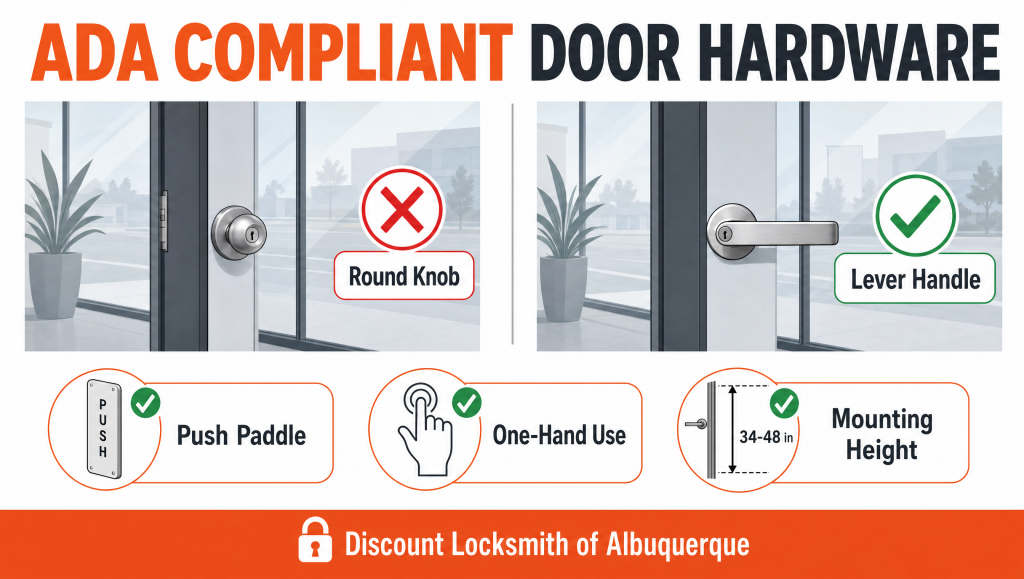
ADA compliant door hardware lets any customer open your entrance with a single hand — no tight grasping, pinching, or twisting of the wrist. Federal accessibility law treats the lock on your front door as part of the building’s accessible route, which means a plain round knob can quietly put a business out of step with the rules.
Many owners discover the gap the hard way: a customer using a wheelchair or living with arthritis cannot work the doorknob, a complaint lands, or an inspector flags the entrance during a remodel. The hardware looked perfectly ordinary, yet it never met the standard set by the Americans with Disabilities Act. The fix is simple once the rules are clear — ADA compliant door hardware that releases the latch with a downward press or a light push, mounted at the correct height, and easy for everyone to operate. As a professional locksmith team that retrofits commercial entrances across the metro, we see the same correctable gaps again and again. Read on to learn what the federal standard actually requires and how to bring your doors in line with it.
ADA Compliant Door Hardware: What the Federal Standards Require
The governing rule comes from the 2010 ADA Standards for Accessible Design, specifically the section on operable parts. In plain terms, hardware on an accessible door must be usable with one hand and must not require tight grasping, pinching, or twisting of the wrist. That single sentence rules out the classic round doorknob, because turning a knob demands exactly the grip the standard prohibits.
Three measurable requirements sit underneath that principle. Operable hardware must be mounted between 34 and 48 inches above the floor. The force needed to release an interior latch is held to roughly five pounds. And the shape itself has to work without a firm grasp, which is why levers, push paddles, and loop handles pass while knobs and small pinch-style turns do not. A professional locksmith measures all three before recommending a replacement, since a lever mounted too high or sprung too stiff can still fall short.
| Door Hardware | How It Operates | ADA Status | What the Standard Says | Recommended Action |
|---|---|---|---|---|
| Round doorknob | Grip and twist the wrist | Not compliant | No tight grasping or twisting | Replace with a lever set |
| Lever handle | Press down with hand, elbow, or fist | Compliant | Operable with one hand, no grasp | Standard accessible upgrade |
| Push paddle / touch bar | Push to release the latch | Compliant | One-hand, grip-free operation | Ideal for glass storefront doors |
| Panic / exit device | Lean into the bar to exit | Compliant | Free egress, no grasp needed | Keep on marked exit doors |
| Small flat thumbturn | Pinch the fingertips to turn | Often falls short | No tight pinching allowed | Swap for a paddle thumbturn |
| Paddle-style thumbturn lock | Turn with a single finger pad | Compliant | Operable without pinching | Accessible interior control |
| Standalone deadbolt | Separate twisting action | Conditional | Must retract in one motion | Pair with lever or interconnect |
| Hardware above 48 inches | Sits outside the reach range | Not compliant | Mount 34 to 48 inches high | Reposition the hardware |
| Over-tensioned door closer | Door is hard to push open | Not compliant | Low operating force at the latch | Adjust the closer tension |
| Loop / U-shaped pull | Pull with an open hand | Compliant | No tight grasp required | Common on accessible pull doors |
The Hardware Types That Meet — and Miss — the Standard
Walk any commercial corridor and you will find a mix of hardware, some compliant and some not. Knowing which is which keeps an owner from swapping the wrong part.
Lever Handles and Push Paddles
Lever handles are the workhorse of an accessible entrance. A user presses down with a hand, an elbow, or a closed fist, and the latch retracts with no grip at all. Push paddles and touch bars on glass storefront doors do the same job. When we upgrade an entrance for accessibility, a graded lever set is usually the first piece we install through our lock repair and replacement service.
The Thumbturn Lock Question
The interior thumbturn lock that secures a door by hand is allowed, but only when it operates without tight pinching. A small, flat tab that forces the fingertips into a pinch can fail the standard, while a larger paddle-style turn passes. On many doors we replace the cylinder and add a compliant turn together through a single lock rekey visit, so one key runs the building and the interior control still meets the rule.
Deadbolts and Exit Devices
A deadbolt is permitted on an accessible door as long as a person can retract it with the same single motion that opens the latch. That often means pairing the bolt with a lever or fitting an interconnected lockset. Panic hardware on exit doors is inherently accessible, since leaning into the bar releases it. Our deadbolt installation work is built around keeping that balance intact.
Where Accessibility and Deadbolt Security Meet
Owners sometimes worry that opening a door to everyone weakens it against intruders. The two goals are not in conflict. Strong deadbolt security comes from the grade of the lock, the strike, and the door itself — not from a hard-to-turn knob. A Grade 1 lever lockset, graded by the Builders Hardware Manufacturers Association, resists forced entry every bit as well as a knob while staying fully operable for a customer with limited hand strength.
The same logic carries into the rest of the building. Many of the home safety habits we recommend to homeowners — solid strikes, reinforced frames, quality cylinders — apply directly to a storefront. Accessibility and protection are layers of one system, and a careful home security review treats them together rather than trading one for the other.
Pro Tip From the Field
After years of retrofitting Albuquerque storefronts, here is the lesson that saves owners a second service call: never measure compliance by the lever alone. We have watched a brand-new accessible handle pass on paper while the door behind it failed in practice — a closer cranked so tight that no customer could push the door open within the force limit, or a raised threshold lip that turned the entrance into a barrier. Check the whole opening: handle height, closer tension, latch force, and the path through the door. Bring in a professional to test the door under real conditions, and you correct the actual experience, not just the part on the order sheet.
Bringing Your Business Into ADA Compliance
A practical retrofit follows a clear order. We survey every public-facing door, note the non-compliant hardware, and confirm mounting heights and operating forces against the standard. From there we replace knobs with graded levers, adjust or swap closers so the door opens under the allowed force, fit compliant thumbturns, and verify the deadbolt retracts in one motion. When a tenant space changes hands, this same survey through our commercial locksmith team keeps the entrance ready for inspection. The U.S. Access Board publishes the full technical guidance, and our role is to translate it into hardware that works on your actual doors. Owners with questions about a specific entrance can reach us through the contact page for a walkthrough.
ADA Compliant Door Hardware: Frequently Asked Questions
What makes door hardware ADA compliant?
Hardware on an accessible door must be operable with one hand and must not require tight grasping, pinching, or twisting of the wrist. Lever handles, push paddles, and loop pulls meet that test, while a round knob does not because turning it demands the grip the standard prohibits.
Are round door knobs allowed on a business entrance?
A standard round knob does not meet the standard on an accessible door, since it requires gripping and twisting. The straightforward correction is a graded lever set, which a professional locksmith can fit to your existing door without replacing the whole assembly.
How high should ADA compliant door hardware be mounted?
Operable hardware must sit between 34 and 48 inches above the finished floor so a person seated or standing can reach it. A lever installed outside that range can still fail an inspection even when the handle itself is the correct accessible type.
Does a thumbturn lock meet ADA standards?
A thumbturn lock is allowed when it operates without tight pinching. A small flat tab that forces the fingertips together can fall short, while a larger paddle-style turn passes. Replacing the turn and the cylinder together keeps the door secure and the interior control accessible.
Can a business keep a deadbolt and still be ADA compliant?
Yes. A deadbolt is permitted as long as a person can retract it with the same single motion that opens the door. Pairing the bolt with a lever or fitting an interconnected lockset keeps strong deadbolt security in place without adding a separate twisting action.
Does accessible hardware weaken deadbolt security?
No. Protection comes from the grade of the lock, the strike, and the door, not from a hard-to-turn knob. A Grade 1 lever lockset resists forced entry as well as a knob while staying operable for a customer with limited hand strength.
Do these principles apply to home safety as well?
They do. The same hardware logic that protects a storefront supports sound home safety: solid strikes, reinforced frames, and quality cylinders. Lever handles also make a home easier to use for aging residents and anyone with limited grip strength.
Make Every Entrance Welcome and Secure
An accessible door is more than a legal box to check — it is the difference between a customer who gets in and one who turns away at the threshold. ADA compliant door hardware does that quiet work on every visit, and getting it right protects both your visitors and your business. The owners who treat the front door as part of the accessible route, rather than an afterthought, are the ones who never field a complaint over a knob. If you are also tightening up the rest of your property, our guide to common security mistakes makes a useful next read.
Let the team at Discount Locksmith of Albuquerque survey your entrances, install compliant hardware, and confirm the work against federal standards. Call (505) 210-8802 to arrange an accessibility and security audit, and find us on the map to see the Albuquerque neighborhoods we serve.