

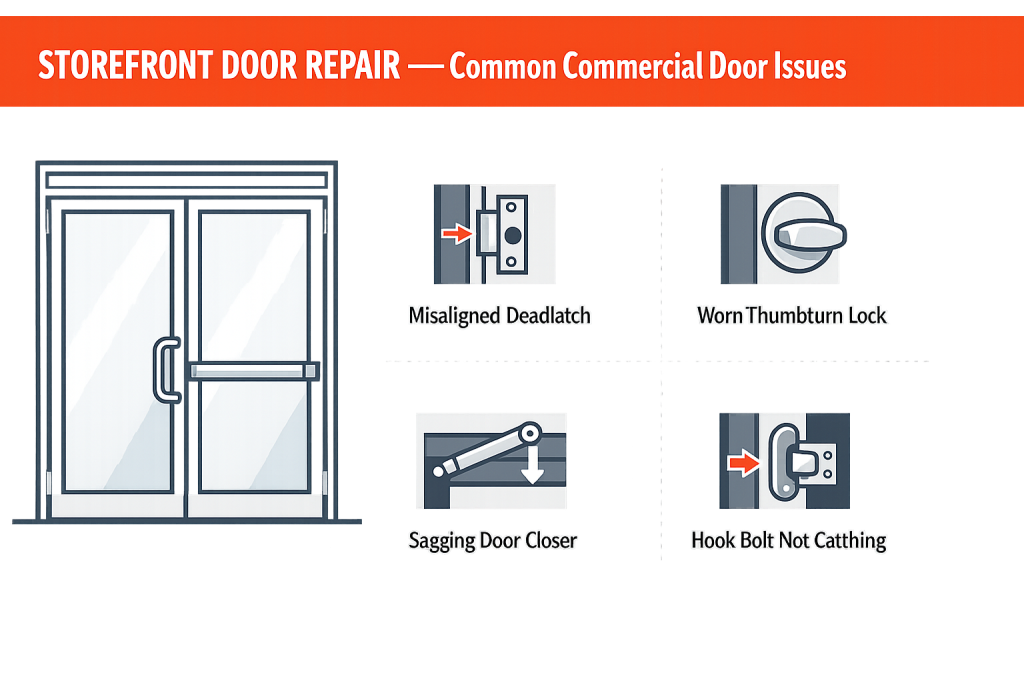
Few things rattle a business owner more than standing at the entrance, key in hand, and feeling the bolt refuse to throw. A storefront door that sticks, drags, or won’t latch is more than an annoyance — it is an open invitation to anyone passing by after closing. The solution is professional storefront door repair that corrects the worn hardware and alignment problems behind the issue, not a surface wiggle that masks them. In this guide, we walk through the most common commercial door problems we see in the field and how a trained technician resolves each one, so keep reading to learn what is really happening at your entrance.
A storefront door that is hard to lock almost always points to one of three culprits: a misaligned deadlatch, a worn mortise lock cam, or a sagging frame. When we diagnose a sticking commercial entrance, we trace the problem back to the specific component rather than forcing the cylinder — because forcing it is exactly what breaks the lock for good.
Common Storefront Door Issues That Make a Commercial Door Hard to Lock
Aluminum-and-glass storefront doors take a beating. They swing hundreds of times a day, sit in direct New Mexico sun, and rely on narrow hardware packed into a thin metal stile. Over time, that combination produces a handful of recurring failures. The most frequent one we encounter is a misaligned hook bolt or deadlatch, where the locking point no longer lines up with the strike in the frame. Heat expansion plays a real role here — Albuquerque’s temperature swings cause aluminum to grow and shrink, shifting the door just enough to bind the bolt.
A second common issue is a tired door closer. When the closer loses hydraulic pressure, the door drifts shut at the wrong angle and never fully seats into the frame, so the latch catches the strike lip instead of the pocket. Worn pivots and bottom hinges create the same symptom by letting the whole door sag. Inside the lock itself, a worn mortise cam or a loose thumbturn lock can leave you turning the key with nothing happening on the other side. Each of these has a distinct fix, and a careful inspection from a professional locksmith tells us which one you are facing.
| Storefront Issue | What You Notice | Likely Cause | Professional Fix | Security Impact |
|---|---|---|---|---|
| Bolt won’t throw fully | Key turns hard or only halfway | Deadlatch misaligned with strike | Realign strike / reset hook bolt | High |
| Door rattles when locked | Loose play in a “locked” door | Worn strike pocket or pivot | Replace strike, adjust pivots | High |
| Thumbturn spins freely | Turning it does nothing inside | Worn mortise cam or spindle | Replace mortise case | High |
| Door drags on closing | Latch hits the strike lip | Sagging closer or bottom pivot | Reset closer, renew pivots | Medium |
| Handle must be lifted to latch | Door drops as it shuts | Worn pivots, frame settling | Adjust or replace pivots | Medium |
| Key sticks on cold mornings | Stiff only at temperature swings | Aluminum frame expansion | Strike adjustment, lubrication | Medium |
| Bolt throws but door pushes open | Latches without grabbing frame | Hook bolt not clearing strike | Re-seat hook bolt and strike | High |
| Worn or copied keys | Several loose keys in use | Aging cylinder | Rekey or upgrade cylinder | Medium |
The Hardware Behind a Storefront Door
To understand storefront door repair, it helps to know what is actually inside that narrow door stile. Commercial entrances use different hardware than the residential locks most people picture, and naming the parts correctly is the first step toward a lasting fix.
Deadlatches and Hook Bolts
Most aluminum storefront doors use a narrow-stile deadlatch or a hook bolt — the category pioneered by hardware makers like Adams Rite — rather than a round residential deadbolt. The hook bolt swings out and grabs the frame, which resists prying on sliding and center-hung doors. When the hook no longer clears the strike, the door feels jammed — and that is the single most common reason owners call us about a stubborn entrance.
Mortise Locks and the Thumbturn Lock
Many heavier commercial doors carry a mortise lock, a rectangular case set into a pocket in the door edge. The interior side often uses a thumbturn lock so staff can secure the door by hand without a key. A loose or spinning thumbturn usually means the spindle or cam inside the case has worn, and replacing that case restores firm, positive locking.
Closers, Pivots, and Strikes
The lock is only half the story. The door closer, the top and bottom pivots, and the strike plate all have to work together so the bolt meets its pocket squarely. A worn pivot lets the door drop a few millimeters, and suddenly the deadlatch sits below the strike. Good storefront door repair always checks alignment, not just the cylinder.
Signs Your Storefront Door Needs Professional Attention
You rarely get one dramatic failure. Instead, the warning signs build slowly. You start lifting the handle to make the latch catch. You jiggle the key to coax the bolt over. The door rattles in its frame when it is supposedly locked, or you can push it open with light shoulder pressure even after locking. Any of these means the locking point and the strike are no longer meeting the way they should.
Ignoring those signs trades a small adjustment for a full hardware replacement later. Worse, a door that only appears locked offers no real deadbolt security at all. If you have already noticed daylight around the frame edge or a bolt that throws only halfway, it is time to bring in a technician before the hardware fails completely. Our commercial lock service covers inspection, adjustment, and replacement on every common storefront system.
How a Professional Locksmith Approaches Storefront Door Repair
When we arrive for a storefront door repair, we start with the door open and the lock disengaged, watching how the door swings and where it contacts the frame. We check the gap along the hinge stile, test the closer’s sweep, and look at wear marks on the strike — those marks tell us exactly where the bolt has been dragging. Only then do we touch the lock.
From there, the repair might mean adjusting the strike, resetting the closer tension, replacing worn pivots, or swapping a failed mortise case. If the cylinder is worn, we rekey or replace it so your existing keys still work across the building. The goal is a door that latches under its own weight, with a bolt that throws fully and a thumbturn that engages with a clean, solid stop. The same diligence we bring to broken key extraction applies here: fix the root cause, protect the surrounding hardware, and leave the entrance stronger than we found it.
Pro Tip From the Field
After more than a decade working on Albuquerque storefronts, here is the lesson that saves owners the most grief: never force a key that suddenly turns hard. That stiffness is the door telling you something has shifted — a sagging pivot, an expanded frame, a strike out of line. When you muscle the key, you transfer all that stress into the lock cam and snap it. Stop, lift the door slightly by the handle to test alignment, and call a professional locksmith while the fix is still a simple adjustment. We have replaced far too many cylinders that a simple strike alignment would have saved.
Deadbolt Security and Access Control for Commercial Entrances
Storefront door repair is also the right moment to think about upgrades. If your entrance still relies on a single worn cylinder, adding a secondary hook bolt or stepping up to a higher ANSI/BHMA-graded mortise lock measurably improves deadbolt security. Many owners pair the repair with keyed-alike cylinders so one key runs the front, back, and stockroom, or move to an electronic access control keypad that removes the risk of copied keys entirely. The same hardware principles that protect a business also protect a home, which is why sound home safety habits and commercial security share so much common ground. Our team can walk your space and recommend the right level of hardware through our full range of locksmith services.
Storefront Door Repair: Frequently Asked Questions
Why is my storefront door suddenly hard to lock?
In most cases the deadlatch or hook bolt has shifted out of line with the strike in the frame. Aluminum doors move with temperature changes and the bolt no longer meets its pocket cleanly. A strike adjustment usually restores smooth locking.
Can a sticking commercial door be repaired, or does it need replacing?
Most sticking doors are repairable. A professional locksmith can realign the strike, reset the closer, renew worn pivots, or swap a failed mortise case without replacing the whole door. Full replacement is only needed when the frame or door itself is damaged beyond adjustment.
What is a thumbturn lock and why does mine spin freely?
A thumbturn lock is the interior lever that lets staff secure the door by hand without a key. When it spins with no resistance, the cam or spindle inside the mortise case has worn out. Replacing the lock case brings back firm, positive locking.
Is it safe to keep using a door that only latches when I lift the handle?
No. Lifting the handle to make it catch means the door has dropped and the bolt is barely engaging. That offers little real deadbolt security and can fail completely. Have the pivots and strike checked before the hardware gives out.
Can you improve security while repairing my storefront door?
Yes. A repair visit is the ideal moment to add a secondary hook bolt, step up to a higher-grade mortise lock, key your doors alike, or add an access control keypad. These upgrades strengthen deadbolt security and reduce the risk tied to copied keys.
Why does my key only stick on cold Albuquerque mornings?
Aluminum frames contract in the cold and expand in the heat. That movement is enough to bind the bolt at certain temperatures. A precise strike adjustment and proper lubrication give the bolt the clearance it needs through every season.
Do the same principles apply to home safety and residential doors?
They do. Alignment, solid strikes, and quality hardware protect a home just as they protect a business. Many home safety problems trace back to the same misaligned bolts and worn cylinders we correct on commercial entrances.
Keep Your Albuquerque Storefront Secure
A door that fights you at lock-up is not a quirk to live with — it is hardware asking for attention, and storefront door repair done right turns it back into an entrance you can trust. The owners who act on the first sticky key are the ones who avoid the lock-up scramble of a door that will not secure at all. If your commercial entrance has started dragging, rattling, or refusing the bolt, let the team at Discount Locksmith of Albuquerque take a look before a minor adjustment becomes a full replacement. You may also want to review the common security mistakes we see at local businesses, since many storefront break-ins trace back to overlooked hardware.
Call (505) 210-8802 to schedule a storefront inspection or a complete security audit, and find us on the map to see the Albuquerque neighborhoods we cover. Let us get your door locking the way it should.