

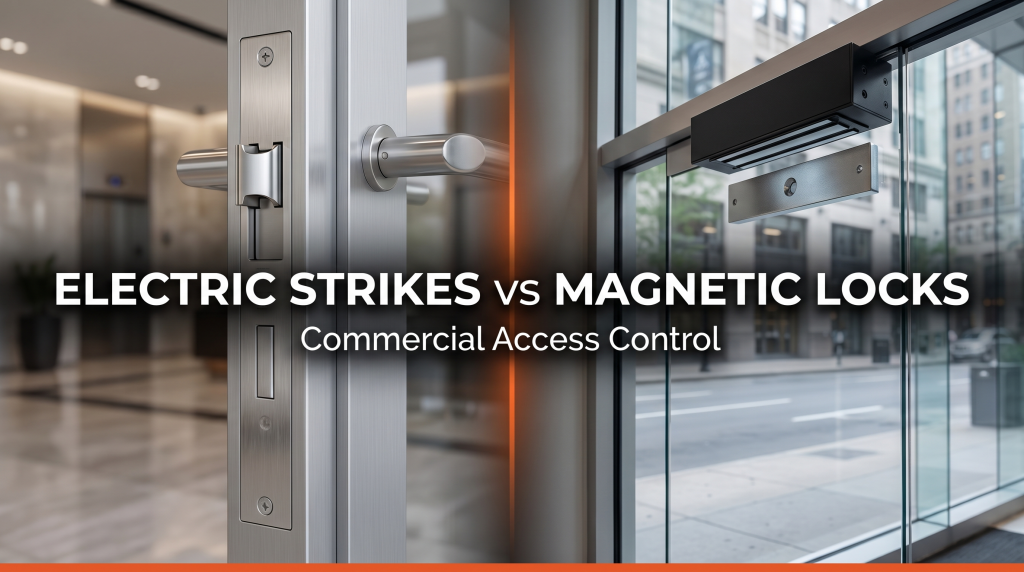
Commercial electric strikes and magnetic locks both control who walks through a door, but they work in opposite ways — and picking the wrong one can leave a business exposed or out of step with the fire code. This guide breaks down how each device functions, where each one belongs, and how a professional locksmith decides which access control solution fits your entry. Keep reading to learn what really separates these two systems.
A storefront or office manager installs an access control system expecting it to lock down the building, then discovers the door either won’t release during a power outage or won’t stay secured against a determined push. That mismatch usually traces back to one decision made early on: electric strike or magnetic lock. The two are not interchangeable, and the right answer depends on the door, the traffic, and the safety code that governs the space.
The solution is understanding what each device does before hardware ever touches the frame. At Discount Locksmith of Albuquerque, we install both systems across retail, office, and multi-tenant buildings, and the selection always starts with how the door needs to behave when power is present and when it is not. Read on to see how the two compare and which one suits your entry.
How Commercial Electric Strikes Work
A commercial electric strike replaces the fixed strike plate that a latch or deadbolt security bolt drops into. Instead of a solid pocket, the strike has a hinged keeper that pivots when the system sends current to it. The door’s existing latch stays mechanically engaged, so the lock body still does its job — the strike simply controls whether the frame releases the latch on command.
Because the mechanical lockset remains in place, a person can still exit by turning the handle or thumbturn lock from the inside. That single feature makes electric strikes a natural match for code-compliant egress on swinging doors. Most units are configured as “fail-secure,” meaning the door stays locked from the outside when power drops, while free exit is preserved through the mechanical handle.
Electric strikes pair well with keypads, card readers, and intercom buzz-in systems, which is why you find them on office suites, apartment lobbies, and back-of-house service doors. A professional locksmith sizes the strike to the latch type — cylindrical, mortise, or rim exit device — so the keeper aligns precisely with the bolt.
Electric Strikes vs. Magnetic Locks: Feature Comparison
The table below summarizes how the two devices differ across the factors that matter most for a commercial entry.
| Feature | Commercial Electric Strike | Magnetic Lock (Maglock) |
|---|---|---|
| How It Secures | Releases the latch of an existing mechanical lockset | Electromagnet bonds to a steel armature plate |
| Default Power Behavior | Typically fail-secure (locked when power drops) | Always fail-safe (releases when power drops) |
| Mechanical Lock Retained | Yes — latch and deadbolt stay active | No — holding force only |
| Best Door Types | Solid wood and metal doors with a lockset | Glass storefront, aluminum-framed, gates |
| Forced-Entry Resistance | High when paired with a Grade 1 lock | Strong against pull, weaker against pry |
| Egress Hardware Needed | Mechanical handle provides free exit | Request-to-exit sensor + release button |
| Fire Code Tie-In | Free egress built into the lockset | Must release on alarm and power loss |
| Access Control Pairing | Keypads, card readers, intercom buzz-in | Keypads, card readers, gate controllers |
| Maintenance Profile | Moving keeper — periodic alignment checks | No moving parts — minimal wear |
| Ideal Use Case | Office suites, service doors, apartment lobbies | Retail storefronts, frameless glass entries |
How Magnetic Locks Hold a Door
A magnetic lock, or maglock, takes a completely different approach. It uses an electromagnet mounted on the frame and a steel armature plate mounted on the door. When energized, the magnet bonds to the plate with a strong holding force, clamping the door shut with no moving parts at all. There is no latch, no keeper, and no mechanical bolt.
That simplicity is the maglock’s strength and its constraint. With no mechanical engagement, the door is only secured while the magnet has power. Maglocks are inherently “fail-safe” — cut the current and the door releases. For that reason, every maglock installation must be tied to the building’s life-safety system so the door unlocks during a fire alarm or power loss, exactly as the NFPA 101 Life Safety Code requires for egress.
Maglocks shine on glass storefront doors, gates, and frameless entries where mounting a strike is impractical. They also handle high-traffic openings well, since there is no latch to wear out. The trade-off is the supporting hardware they demand: a request-to-exit sensor, a clearly marked release button, and often a backup release so occupants are never trapped behind a door that lost power.
Matching the Device to the Door
Choosing between the two comes down to a few practical questions about the opening. The door’s construction is the first filter — a solid wood or metal door with a standard lockset favors an electric strike, while a glass or aluminum-framed door usually points toward a maglock.
The next factor is egress behavior. A door on a primary exit path that must stay secured during a power failure calls for a fail-secure electric strike. A door that must release the moment an alarm sounds — common on stairwell and corridor openings — is better served by a fail-safe maglock wired into the alarm panel.
Holding strength matters too. Maglocks resist a straight pulling force impressively, but they offer little against prying once the bond is broken. Electric strikes, by contrast, keep the mechanical latch working, so the underlying lock’s home safety and forced-entry resistance still apply. For openings that need both controlled access and genuine break-in resistance, the electric strike paired with a Grade 1 lockset is often the stronger pairing, as graded by the Builders Hardware Manufacturers Association.
🔧 Pro Tip: Plan the Egress Hardware Before You Pick the Lock
Across the commercial access control installations we have handled in Albuquerque, the single most overlooked step is egress planning. Property owners focus on keeping people out and forget that the code cares just as much about letting people leave without a key, tool, or special knowledge.
Before selecting a maglock, map every release device the opening will need: the request-to-exit motion sensor, the push-to-exit button, and the auxiliary release that satisfies the inspector. We have walked into more than one building where a maglock was installed cleanly but failed inspection because the egress side was an afterthought. Sorting that out first prevents a rip-and-replace later and keeps the lock repair callbacks to a minimum. When the egress plan is settled, the choice between strike and maglock usually makes itself.
Frequently Asked Questions About Commercial Electric Strikes and Magnetic Locks
Are commercial electric strikes more secure than magnetic locks?
It depends on the door and the threat. A commercial electric strike keeps the mechanical latch and deadbolt engaged, so it pairs with a Grade 1 lockset to resist prying and forced entry. A magnetic lock resists a straight pull extremely well but offers little once the bond is broken. For a solid door that needs break-in resistance, the electric strike paired with a strong lock is usually the more secure choice.
What is the difference between fail-safe and fail-secure?
Fail-safe means the door releases when power is lost — every magnetic lock works this way, which is why it must tie into the fire and alarm system. Fail-secure means the door stays locked from the outside when power drops, while free exit is preserved through the mechanical handle. Most commercial electric strikes are configured fail-secure, though they can be set either way depending on the opening.
Can I put a magnetic lock on a glass storefront door?
Yes — glass and aluminum-framed doors are where maglocks perform best, since there is no pocket to mount a strike into. The installation needs a properly mounted armature plate, a request-to-exit sensor, and a clearly marked release button so occupants can always leave. A professional locksmith confirms the bracket style matches your frame before installation.
Do magnetic locks meet fire and egress codes?
They can, when installed correctly. Because a maglock holds the door shut electrically, it must be wired to release on a fire alarm signal and on power loss, with the required egress devices in place. The NFPA 101 Life Safety Code sets the rules for how these doors must unlock on an exit path. A licensed locksmith installs the supporting hardware so the opening passes inspection.
Will an electric strike work with my existing lock?
In most cases, yes. The electric strike replaces the fixed strike plate in the frame while your current lockset stays in place, so the latch still drops into the keeper. The key is matching the strike to your latch type — cylindrical, mortise, or rim exit device. A locksmith measures the existing hardware and selects a strike that aligns precisely with the bolt.
Which option is better for a high-traffic entrance?
Magnetic locks handle constant use well because they have no moving parts to wear out — nothing latches or releases mechanically. Electric strikes are also durable, but the moving keeper benefits from periodic alignment checks on a busy door. For a frameless glass entry with heavy foot traffic, a maglock with proper egress hardware is often the cleaner long-term solution.
Securing the Right Entry, the Right Way
Electric strikes and magnetic locks are not competitors so much as two tools built for different doors. The strike keeps a mechanical lock in play and suits fail-secure openings with standard locksets; the maglock delivers clean, latch-free holding on glass and high-traffic doors that must release on alarm. Reading the door, the traffic, and the egress code correctly is what separates a system that protects a business from one that frustrates it.
Our team installs, integrates, and services both systems for retail, office, and residential properties across the metro. To plan an entry upgrade or schedule a security audit, contact Discount Locksmith of Albuquerque — and find us on Google Maps to see what local businesses have said about our work. If you are also tightening up the rest of the building, our guide to a complete home security audit is a practical next step toward full-perimeter protection.